

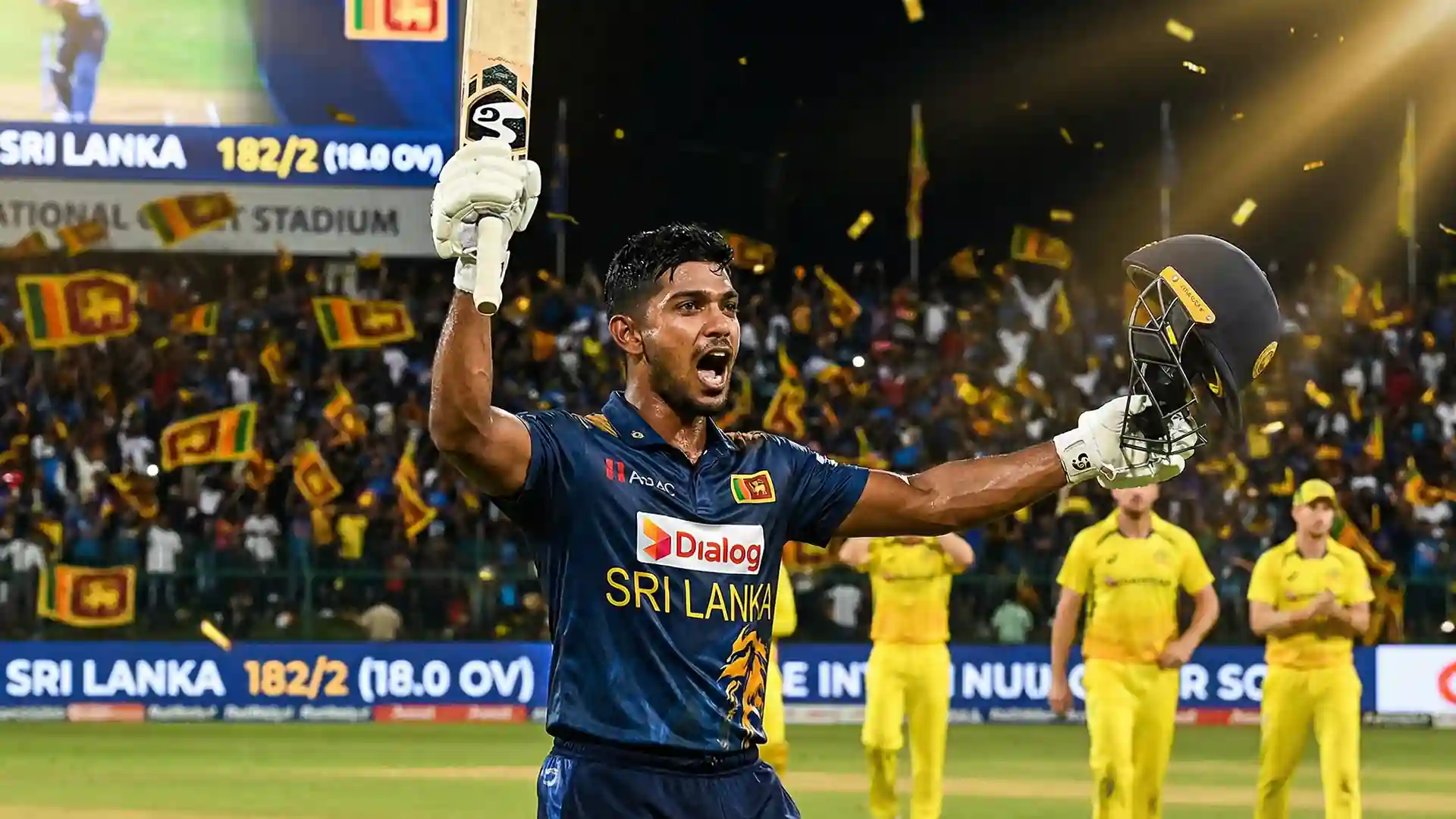
Sri Lanka Vs Australia ICC T20 CRICKET WORLD CUP 2026 Full Highlights Match 30 – SL Vs AUS
The ICC Men’s T20 World Cup 2026 delivered one of its most dramatic chapters on February 16, 2026. Match 30 between Sri Lanka and Australia at the Pallekele International Cricket Stadium in Kandy was supposed to be a virtual knockout for Australia. It turned into a historic triumph for Sri Lanka. The Lions chased down 182 with eight wickets in hand. In doing so, they secured a spot in the Super 8 stage and pushed Australia to the edge of elimination.
This article covers every phase of Match 30 in detail. It breaks down the tactics, the turning points, and the records that were shattered on a memorable night in Kandy.
Tournament Context Before Match 30
The buildup to this game was intense. Group B had been unpredictable from the start. Sri Lanka entered the match with two convincing wins over Ireland and Oman. They carried momentum despite pre-tournament doubts following a 3-0 series loss to England in late 2025. The home crowd in Kandy was ready to roar.
Australia, on the other hand, arrived in crisis mode. Their shocking 23-run loss to Zimbabwe at the R. Premadasa Stadium had exposed serious weaknesses. Their middle order looked fragile. Their ability to handle disciplined spin bowling was questionable.
Australia sat third in the Group B standings. They were ranked second in the world but were staring at a potential group-stage exit. For the eighth-ranked Sri Lanka, this was a golden opportunity. They could dismantle the established hierarchy of T20 cricket on home soil in front of their own fans.
The atmosphere at the packed Pallekele stadium was electric. This was the first major T20 clash between the two sides since October 2022. Every cricket fan in Sri Lanka knew the stakes. A win would send them through. A loss could end Australia’s World Cup campaign.
Squad Selection and Pre-Match Decisions
Both teams faced significant selection challenges before the first ball was bowled.
Australia’s Selection Headaches
Australia’s biggest talking point was the return of captain Mitchell Marsh. He had missed the first two matches due to a testicular injury suffered during training. His inclusion in the playing XI forced the controversial exclusion of Matthew Renshaw. Renshaw had been Australia’s most consistent performer in the tournament. He top-scored with 65 against Zimbabwe.
Steve Smith had also been activated as a replacement for the injured Josh Hazlewood. Smith was in brilliant form during the 2025/26 Big Bash League. He averaged nearly 60 with a strike rate of 167.97. However, the selectors chose not to include him in the final XI. They preferred the power-hitting potential of Cameron Green and Marcus Stoinis.
Sri Lanka’s Injury Concerns
Sri Lanka also dealt with key absences. Their premier leg-spinner and tactical weapon, Wanindu Hasaranga, was out with a hamstring tear. His replacement was Dushan Hemantha. Hemantha had a rough outing against Oman, conceding 45 runs. Many questioned whether he could contain an aggressive Australian top order.
Feature | Australia | Sri Lanka |
Captain | Mitchell Marsh | Dasun Shanaka |
Key Inclusions | Mitchell Marsh, Cooper Connolly, Xavier Bartlett | Kusal Mendis, Dushan Hemantha |
Key Exclusions | Matthew Renshaw, Steve Smith (Reserve) | Kamil Mishara |
Injury Impact | Hazlewood (Out), Marsh (Recovered) | Hasaranga (Out), Pathirana (Ongoing) |
Bowling Focus | Pace and Variations (Ellis, Bartlett) | Spin Dominance (Theekshana, Wellalage) |
Playing XIs
The final lineups reflected two different philosophies. Australia leaned on multi-functional pace all-rounders. Sri Lanka relied on specialized spin-bowling variations.
Australia XI: Travis Head, Mitchell Marsh (c), Cameron Green, Josh Inglis (wk), Tim David, Marcus Stoinis, Glenn Maxwell, Cooper Connolly, Xavier Bartlett, Nathan Ellis, Adam Zampa.
Sri Lanka XI: Pathum Nissanka, Kusal Perera, Kusal Mendis (wk), Pavan Rathnayake, Dasun Shanaka (c), Kamindu Mendis, Dunith Wellalage, Dushan Hemantha, Dushmantha Chameera, Maheesh Theekshana, Matheesha Pathirana.
Pitch and Conditions at Pallekele
The Pallekele International Cricket Stadium has a well-known character. It supports high-scoring cricket in the early overs. Then it turns into what experts call a “slow poison” surface. The pitch used for Match 30 was described as slightly slow and two-paced. It offered true bounce during the first 10 overs. After that, spinners found increasing assistance.
Historical data from Pallekele shows an average first-innings score of around 168. A total above 185 is generally considered a winning score. Chasing under lights becomes harder as the surface gets tacky and slow.
Captain Dasun Shanaka chose to field first after winning the toss. This was a calculated risk. He believed his spin bowlers could restrict Australia below 180. He also hoped that minimal dew might aid the batting side in the second innings.
First Innings: Australia Bat — 181 All Out (20 Overs)
Phase 1: The Powerplay Blitz (Overs 1–6)
Australia’s intent was clear from ball one. Mitchell Marsh and Travis Head attacked the new ball with purpose. They targeted Dushmantha Chameera in the opening over. They extracted 14 runs through powerful strokes and a towering six.
A critical moment came in the third over. Matheesha Pathirana, Sri Lanka’s premier fast bowler, pulled up with a hamstring strain. He had bowled only four deliveries. This disrupted Sri Lanka’s death-bowling plans. Shanaka had to use part-time options earlier than he wanted.
Mitchell Marsh looked determined to silence his critics. In the sixth over, he attacked Maheesh Theekshana’s mystery spin. He smashed five consecutive fours. The Powerplay ended with Australia at a dominant 70/0. This was Australia’s fourth-highest Powerplay total in T20 World Cup history.
Phase 2: The Century Stand and the Turning Point (Overs 7–10)
The assault continued after the fielding restrictions ended. By the end of the eighth over, Australia reached 97/0. A total above 220 looked possible.
Travis Head reached his fifty in just 27 balls. It was his first half-century in 13 T20I innings. It signaled a welcome return to form. Mitchell Marsh followed with his fifty in 25 balls. He hit 8 fours and 2 sixes along the way.
Then came the pivotal moment of the entire match. It happened in the ninth over.
Dushan Hemantha, the bowler under the most scrutiny, delivered a beautifully flighted ball. Travis Head tried to launch it over long-off. He mistimed the shot. Kamindu Mendis took a comfortable catch. The 104-run opening partnership was broken.
From absolute dominance at 104/0, the Australian innings began a spectacular collapse.
Partnership Milestone | Overs | Runs | Significance |
50-run mark | 4.3 | 51 | Fastest of the tournament for Australia |
Powerplay Total | 6.0 | 70/0 | Joint-highest vs Sri Lanka in T20 World Cups |
100-run mark | 8.2 | 104 | Fastest team century at Pallekele |
Phase 3: The Middle-Order Collapse (Overs 11–15)
Dunith Wellalage entered the attack and further squeezed the scoring rate. Cameron Green looked uncomfortable from the start. He was stumped for 3 after being drawn forward by a wider delivery from Wellalage.
In the following over, Hemantha trapped Mitchell Marsh LBW for 54. The captain’s departure sent shockwaves through the Australian camp. Tim David fell shortly after. He was caught at long-off for 6 while trying to force the pace against Kamindu Mendis.
In the span of just four overs, Australia slumped from 104/0 to 130/4. The middle order failed to adjust to the changing conditions. The Pallekele pitch had become tacky. High-risk aerial shots were increasingly dangerous. The Australian batters tried to play aggressively. The surface punished them for it.
Phase 4: The Death-Over Strangle (Overs 16–20)
Josh Inglis and Glenn Maxwell attempted a brief recovery. They added 30 runs for the fifth wicket. But a moment of fielding brilliance ended their resistance.
Glenn Maxwell tried a reverse sweep off Hemantha. Pathum Nissanka, fielding at backward point, dove to his left. He took an astounding catch that left the crowd in disbelief. It was the highlight of the fielding innings.
The final overs belonged to Dushmantha Chameera. Despite an expensive opening spell, Chameera executed a tactical masterclass at the death. He used pace variations to stifle the lower order. The final four Australian wickets fell for just six runs in 12 balls. Two clinical run-outs ended the innings at 181 all out on the last delivery of the 20th over.
Australia lost 10 wickets for 77 runs in the final 70 balls of their innings. It was a catastrophic collapse. They ended up roughly 20 to 30 runs short of a par total on that surface.
Australian Fall of Wickets Summary
Wicket | Score | Over | Batter | Mode of Dismissal |
1st | 104 | 8.3 | Travis Head | Caught off Hemantha |
2nd | 110 | 10.0 | Cameron Green | Stumped off Wellalage |
3rd | 116 | 10.4 | Mitchell Marsh | LBW to Hemantha |
4th | 130 | 12.4 | Tim David | Caught off Kamindu Mendis |
5th | 160 | 16.1 | Glenn Maxwell | Caught off Hemantha |
6th | 174 | 17.5 | Josh Inglis | Bowled by Chameera |
7th | 177 | 18.3 | Cooper Connolly | Bowled by Theekshana |
8th | 180 | 19.3 | Marcus Stoinis | Bowled by Chameera |
9th | 180 | 19.5 | Xavier Bartlett | Run Out (K. Mendis) |
10th | 181 | 19.6 | Adam Zampa | Run Out (K. Mendis) |
Sri Lankan Bowling Performance Breakdown
The resurgence of the Sri Lankan bowling unit after the Powerplay was remarkable. Dushan Hemantha silenced all his critics with career-best figures of 3/37. His ability to vary his pace between 85 and 95 kph and extract drift was the primary weapon against Australia’s top order.
Here is a breakdown of the key bowling performances:
- Dushan Hemantha: 4-0-37-3 (Economy: 9.25). His dismissal of Travis Head at 104/0 flipped the entire script of the match.
- Dunith Wellalage: 4-0-33-1 (Economy: 8.25). He provided crucial control through the middle overs. He did not concede a single six.
- Dushmantha Chameera: 4-0-36-2 (Economy: 9.00). His death-bowling spell was superb. The dismissal of Josh Inglis with a 140 kph bouncer was a standout delivery.
- Kamindu Mendis: Chipped in with the key wicket of Tim David.
The Sri Lankan spinners accounted for 6 of the 10 wickets. This exposed Australia’s ongoing struggle against quality spin on deteriorating tracks.
Second Innings: Sri Lanka Chase — 182/2 in 18 Overs
Chasing 182 was no easy task. It was the highest target ever set at the Pallekele International Cricket Stadium. Sri Lanka needed discipline and belief. They showed both.
The Early Setback
The chase started badly. Kusal Perera, traditionally dangerous against Australia, fell for just 1 run in the second over. Marcus Stoinis induced a thick edge. The catch was taken at deep backward point. Sri Lanka were 8/1. The pressure was on.
The Stabilization: Mendis and Nissanka Build
Kusal Mendis walked in to join Pathum Nissanka. The pair began a calm and calculated recovery. Unlike Australia’s frantic aggression, the Sri Lankan duo focused on smart strike rotation. They picked boundaries with precision rather than force.
Nissanka was the artist. He used impeccable timing and bat speed to exploit gaps in the field. Mendis played the perfect supporting role. He attacked from the start to keep the required run rate manageable.
The Powerplay ended with Sri Lanka at 61/1. They were slightly behind Australia’s pace but far more stable. Through the middle overs, the pair neutralized Adam Zampa and Cooper Connolly. Both batters reached their half-centuries in the 12th over. Their partnership reached 97 runs off just 66 balls.
The Partnership Breaks, Nissanka Accelerates
The second-wicket stand was broken in the 13th over. Mendis was caught at deep mid-wicket off Stoinis for 51. It was his third fifty of the 2026 competition. But his departure did not slow Sri Lanka down. It only served as a catalyst for Nissanka to shift gears.
Nissanka’s Record-Breaking Century
Pathum Nissanka’s unbeaten 100 off 52 balls was a breathtaking display of versatility and composure.
His scoring covered all parts of the ground:
- Against Pace: He used gentle pulls and elegant flicks to counter Nathan Ellis’s yorkers. He timed the ball rather than trying to overpower it.
- Against Spin: He danced down the pitch to loft Adam Zampa over his head. He used the sweep shot effectively against googly variations.
- Clutch Hitting: In the 15th over, Nissanka targeted Marcus Stoinis. He extracted 20 runs from a single over to bring the target within easy reach.
Nissanka reached his century with a calm single through mid-on in the 18th over. It was the second T20I century of his career and the first of the 2026 World Cup. The Pallekele crowd erupted.
Pavan Rathnayake provided the finishing touches. He scored an unbeaten 28 off 15 balls. A boundary behind square leg sealed the eight-wicket victory with 12 balls to spare.
Sri Lanka Batting Summary
Metric | Value | Significance |
Target Chased | 182 | Record T20I chase at Pallekele |
Pathum Nissanka | 100* (52 balls) | First century vs Australia in T20 WC history |
Kusal Mendis | 51 (38 balls) | Third fifty of the 2026 competition |
Pavan Rathnayake | 28* (15 balls) | Strike Rate: 186.67; crucial late support |
Overs to Spare | 2.0 | Demonstrated total dominance in the chase |
Australian Bowling Breakdown: Where It Went Wrong
The gap in bowling quality between the two sides decided the result. Australian bowlers looked toothless on a surface that demanded subtle changes of pace and smart variations.
Adam Zampa’s Struggles
Adam Zampa entered the match with an outstanding record against Sri Lanka. He had 21 career T20I wickets against them at an average of 13. But Nissanka and Mendis took him apart. They used the sweep and reverse sweep to disrupt his length. Zampa’s economy rate of 10.25 was his highest in recent World Cup fixtures. The Sri Lankan batters showed tactical maturity that he could not counter.
Pace Bowling Failures
Nathan Ellis struggled with the wet ball and tacky surface. Xavier Bartlett, still relatively inexperienced in subcontinental World Cup conditions, could not deliver the consistent change of pace needed to deceive Nissanka. Marcus Stoinis was the only wicket-taker with figures of 2/46. But his expensive economy rate was a byproduct of an overly aggressive approach that played into the hands of the chasing batters.
Bowler | Economy Rate | Key Observation |
Adam Zampa | 10.25 | Unable to extract turn; outplayed by Nissanka |
Marcus Stoinis | 11.50 | Sole wicket-taker but lacked control |
Nathan Ellis | 10.66 | Lacked variation execution under lights |
Xavier Bartlett | 11.00 | Inexperienced in subcontinental World Cup conditions |
Captaincy and Leadership Under Pressure
The contrasting leadership styles were a major talking point after the match.
Dasun Shanaka’s Calm Under Fire
Shanaka led Sri Lanka with composure. Even when Australia were flying at 104/0, his body language remained positive. He regrouped the squad after losing Pathirana to injury. He rotated his bowlers intelligently. His decision to bring Hemantha on at the right time changed the game. His post-match comments revealed confidence in the venue’s nature. He said his team always believed the surface would slow down and bring them back into the contest.
Mitchell Marsh’s Difficult Night
Marsh was under intense scrutiny. His decision to drop Renshaw and include an under-prepared middle order was questioned by analysts. It was called a contentious selection call. In the post-match press conference, Marsh looked devastated. He admitted that his team had lost their way. He said Australia was now “in the lap of the Gods” regarding qualification.
Key Post-Match Quotes
- Dasun Shanaka: Emphasized the team’s belief in the venue’s data. He noted they were confident even at 110/0 because they knew the surface would slow down.
- Mitchell Marsh: Admitted 181 was competitive but that the execution in the back end of the innings was the failure point.
- Pathum Nissanka: Credited the coaching staff and the guidance of Jehan Mubarak, the U-19 coach traveling with the squad, for his mental preparation.
Records and Milestones Broken in Match 30
Match 30 shattered several long-standing T20 World Cup records.
- Individual Century: Pathum Nissanka became only the second Sri Lankan batter to score a T20 World Cup century. The first was Mahela Jayawardene, who scored 100 against Zimbabwe in 2010.
- Highest Chase: The 182-run target was the highest total ever chased by Sri Lanka in T20 World Cup history. It surpassed their 172-run chase against Bangladesh in 2021.
- First Century Against Australia: No batter had ever scored an individual century against Australia in T20 World Cup history. Nissanka was the first.
- Historic Collapse Echo: Australia’s loss of 10 wickets for 77 runs echoed their 2011 failure in Pallekele. Back then, they collapsed from 71/0 to 149 all out against the spin of Ajantha Mendis.
- Career Milestone: Pathum Nissanka crossed the 2,500-run milestone in T20Is. He became the second Sri Lankan to reach this mark, alongside Kusal Mendis.
Impact on Super 8 Qualification
The result had immediate and far-reaching consequences.
Sri Lanka Qualify
Sri Lanka became the fifth team to officially qualify for the Super 8 stage. They joined India, South Africa, England, and the West Indies. As co-hosts and an undefeated side, they sent a strong message to the rest of the tournament.
Australia on the Brink
Australia’s future now depends on results outside their control.
Scenario | Requirements for Australia |
Scenario A (Most Likely) | If Zimbabwe beat Ireland, Australia are officially eliminated. |
Scenario B (Moderate Chance) | If Ireland beat Zimbabwe, Australia must beat Oman by a massive margin to improve their NRR. |
Scenario C (Unlikely) | If Zimbabwe lose both remaining matches, a three-way tie on 4 points occurs. Net Run Rate decides. |
Australia’s current Net Run Rate of +0.414 is significantly lower than Zimbabwe’s +1.984. Even a victory over Oman might not be enough if Zimbabwe wins just one more game.
Sri Lanka as Title Contenders
Sri Lanka’s predicted Super 8 grouping will likely pit them against England, South Africa, and one of Pakistan or the USA. Their ability to win Match 30 despite losing Hasaranga and Pathirana shows impressive squad depth. It makes them genuine title contenders for the first time since their 2014 victory.
Conclusion: A Night That Shifted Power in Group B
Match 30 of the 2026 ICC T20 World Cup was more than a game of numbers. It was a demonstration of the evolving technical landscape of T20 cricket.
The Australian juggernaut, once defined by relentless pace and raw aggression, was dismantled by the surgical precision and local intelligence of a resurgent Sri Lankan side. Pathum Nissanka’s century proved that classical batting technique still holds immense value in a power-hitting era. Timing and placement can overcome brute force.
For Australia, this match exposed their long-standing weakness. Their inability to navigate quality spin on deteriorating pitches remains a critical vulnerability. The absence of Pat Cummins and the retirement of Mitchell Starc left their pace attack short of firepower. Their middle order failed under pressure when the conditions shifted.
As the tournament moves to the Super 8 phase, Sri Lanka are no longer just co-hosts. They are architects of a new tactical approach. Australia must now face the harsh reality of a potential early exit. For several of their T20 veterans, this could mark the end of their World Cup journeys.
The night in Pallekele will be remembered. It was the moment Group B tilted decisively toward the subcontinent. Sri Lanka’s Lions roared, and the cricket world listened.